Fabric guide
Our advice to choose, wear and make every piece last.
Three trends to keep this season, and one to skip
The collections lighten the wardrobe rather than reinvent it. We sort through them, piece by piece.
Summer-Autumn 2026 isn't reinventing the women's wardrobe — it's lightening it. Three clear directions emerge from the collections: relaxed tailoring, a refined pastel palette, and a return of fluid pieces in natural fabrics. Here's how to read these trends and which ones are actually worth weaving into your wardrobe.
The oversized blazer, but not the one you already own
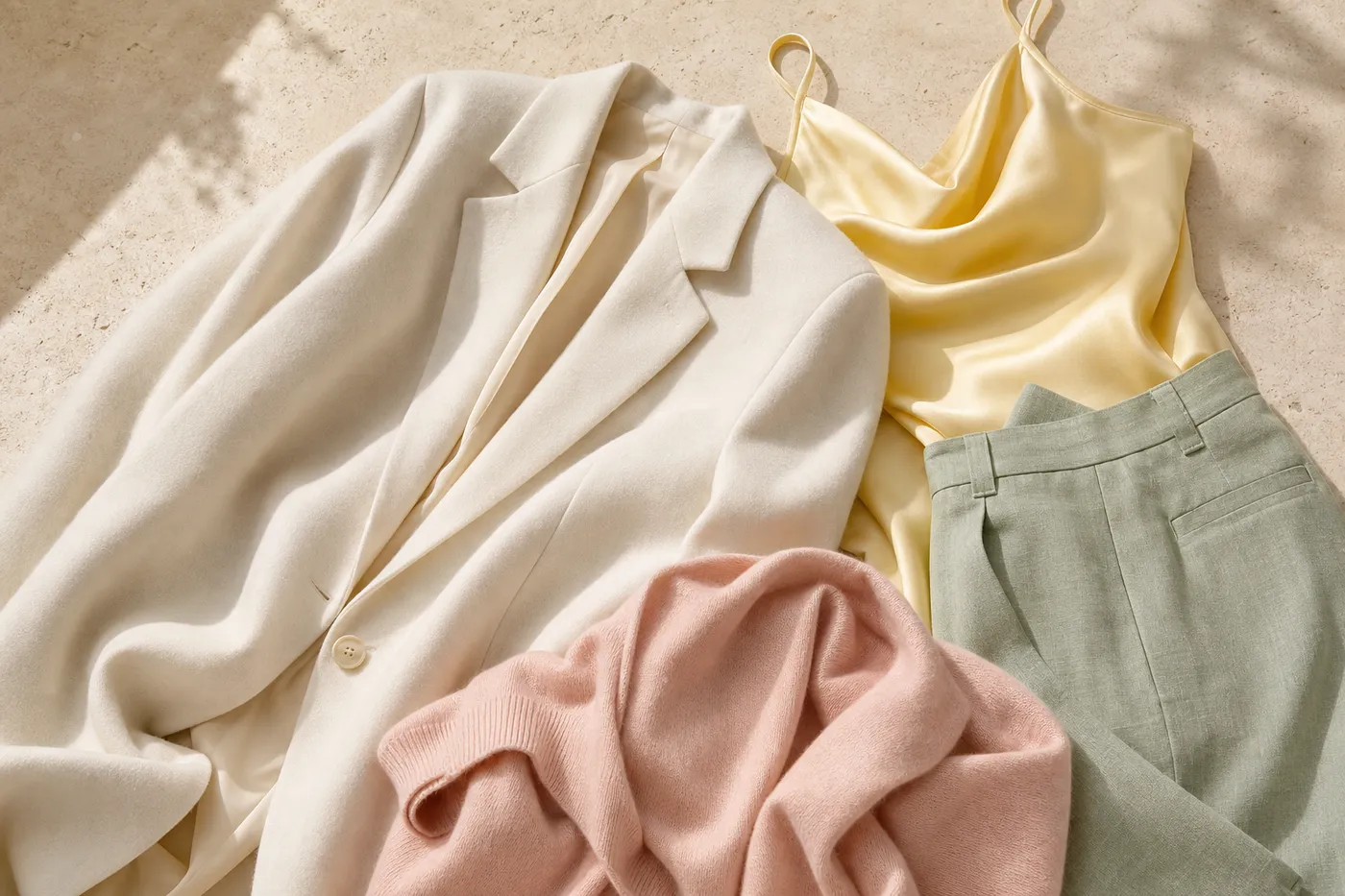
The relaxed blazer remains the season's anchor piece. The shift compared to last year: shoulders are softer, the cut runs longer (mid-thigh), and the fabric is lighter — fresh wool, linen blends, fine gabardine. The idea is no longer to borrow the menswear codes but to propose a clean silhouette that stays feminine thanks to fluidity.
The fitting-room test: if the jacket falls naturally when you drop your arms — no folds, no pull at the waist — the cut is right. The single mistake to avoid is a blazer that's too thick. Over a T-shirt in April, it suddenly looks heavy.
Pastels, layered
The pastel palette is back, but read differently. Instead of candy tones, think buttercream, sage green, dusty lilac, blush. These shades work tone-on-tone — a butter knit over a cream skirt, a sage blazer over a light khaki trouser. The simple rule: two pastels maximum per outfit, separated by a neutral (off-white, beige or raw denim).
The fabrics that change the silhouette
Washed linen returns on shirts, long dresses and fluid trousers. Tencel silk shows up on pleated skirts and draped tops. Oversized cuts only work if the fabric moves with the body: on stiff cotton, the same shape reads heavy. In the fitting room, do a side-step movement — the piece should fall back into shape without folding.
Key takeaways
- A relaxed blazer in a light fabric replaces last year's structured jacket.
- Layered pastels — close tones together — read more refined than blocks of bright colour.
- Fluid pieces need fabric that moves; do a movement test before buying.
- Two pastels separated by a neutral avoids the candy effect.
- One trend piece per outfit is enough; the rest stays classic.
The smartest way to bring these directions into the wardrobe without replacing it: pick one statement piece (a blazer or a pastel dress) and pair it with basics you already own. Trends that last are the ones that slip into an existing wardrobe without breaking it.
Seen on the street: the silhouettes of the season
What the women who make fashion wear between two shows, and what to keep for everyday.
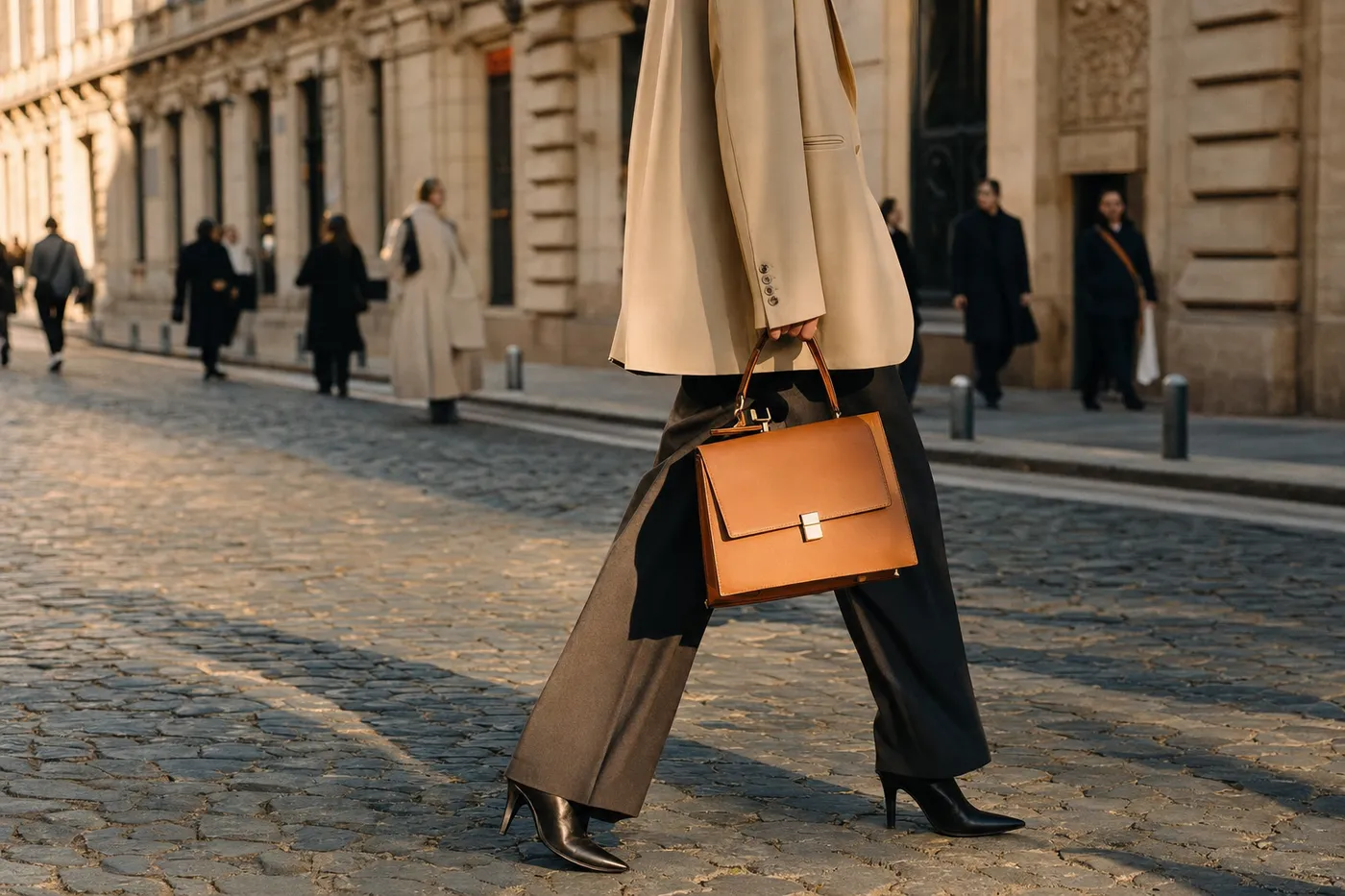
Fashion-week street style is a useful observation deck — provided you watch for what recurs rather than what stands out. The streets of Paris, Milan, London and New York agreed this winter on four crisp silhouettes — the ones that come through on photos without the central piece needing to be recognisable. Here are the four trends that took hold, with no street names and no signatures cited.
Silhouette 1 — Long coat, flat shoes
The most-spotted combo was a generous coat below the knee, worn with a flat — loafer, derby or low boot. The proportion works because the length of the coat lengthens the silhouette while the flat stabilises it. Seen across nearly every capital, in neutral colours: cream, brown, khaki, black.
Silhouette 2 — Relaxed tailoring + denim
Oversized blazer in wool or a linen blend, raw-hem straight jean, white T-shirt underneath. It's the end-of-show formula — the one that shows up in the streets as crowds spill out of venues. The shared detail: the blazer is slightly too big for the wearer, and that's intentional. A structured day bag finishes the outfit.
Silhouette 3 — Maxi dress + knit
A long fluid dress (linen, silk or viscose) with a fine knit pulled over the top. The dress peeks below the knit, the look creates two lengths. Seen in soft tones or contrasted (cream dress + black knit, green dress + beige knit). A flat boot or a discreet trainer at the foot.
Silhouette 4 — Tonal head-to-toe
A single colour from head to toe, in close shades — beige on beige, grey on grey, brown on brown. The hardest silhouette to wear without looking flat, but also the most elegant when it works. The key: vary fabrics (wool + leather + linen) so light catches them differently.
The accessory thread
- The structured day bag, medium size, in natural leather — seen in most photos.
- Discreet sunglasses, square or oval frames, acetate.
- A scarf knotted loosely at the neck or as a belt — a recurring detail.
- Fine gold jewellery (small earrings, choker) over silver.
- Flat shoes — barely any heels. The afternoon stiletto is over.
What these four silhouettes share: none requires a statement piece. They're combinations of elements already present in a thoughtful wardrobe, simply assembled in the right proportions. That's the main lesson from this season's street style — trends pass, proportions stay.
The white shirt, twelve different ways
Tucked into wide trousers, open over a top, knotted at the waist: the most versatile piece in the closet, revisited.
The white shirt is probably the most underestimated piece in the women's wardrobe. It carries across seasons, ages and occasions without going out of style. The problem: most of us wear it the same way and grow tired of it. Here are twelve ways to wear it, grouped by register, with what actually changes the silhouette.
At work (3 ideas)
- White shirt tucked into high-waist tailored trousers, thin belt, leather loafers. The simplest formula to execute, and probably the most reliable.
- White shirt under a fine crew-neck knit, with only the collar and cuffs showing. Structured effect without the formality of a blazer.
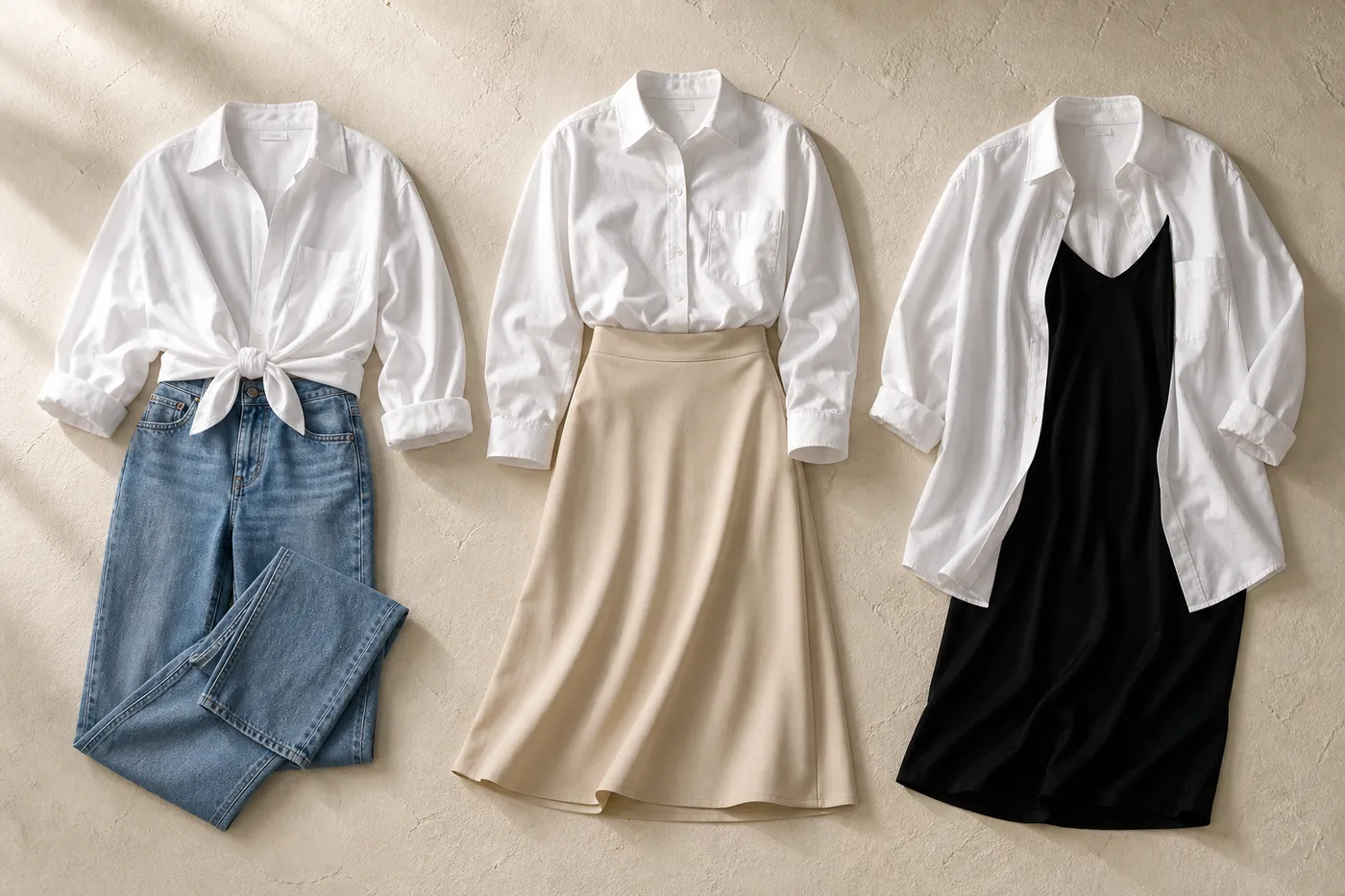
- Oversized white shirt under a black blazer, straight jean below. A thin leather tie or a loose-knotted scarf transforms the outfit in fifteen seconds.
On the weekend (3 ideas)
- White shirt knotted at the waist over a straight jean, white trainers. The piece relaxes without becoming careless.
- White shirt half-tucked into a midi linen or silk skirt, flat sandals. Saturday-noon market-then-terrace energy.
- White shirt open over a white T-shirt, tailored shorts, loafers. A spring silhouette that holds up even at 25 degrees.
In the evening (3 ideas)
- White shirt tucked into a long satin skirt, thin sandals, one statement piece of jewellery. The contrast between dry cotton and silk is very flattering in warm light.
- White shirt open over a fine-strap black top, fluid black trousers. The open collar frames the face better than a deep neckline.
- White shirt with rolled sleeves over black velvet tailored trousers, low-heel pumps or ankle boots. More elegant than a dress on a day when the dress has already been worn.
As a layer (3 ideas)
- White shirt under a sleeveless dress, with the collar and cuffs peeking out. Useful in mid-season, and stretches a summer dress further into the year.
- White shirt worn as a light jacket, open, over a fine camisole. An alternative to spring blouses for those who don't love blouses.
- White shirt knotted into a crop top over wide-leg trousers on a defined waist. Sportswear-luxe effect, that flatters a wide range of body shapes.
Three details that make the difference
- Fabric: poplin or dry cotton for a crisp hold, linen for a softer feel. Avoid soft fabrics that collapse at the collar.
- Cut: slightly tailored at the bust, fluid at the hips. Avoid heavily oversized cuts on smaller frames — the shirt then wears the body.
- Length: long enough to stay tucked, but not so long that it can't be worn open over trousers.
The same shirt can therefore be worn at least once a week, in radically different contexts, without repeating a silhouette. That's what makes it, on the medium term, the best price-per-wear ratio in the wardrobe — far ahead of a trend piece that only comes out once per season.